

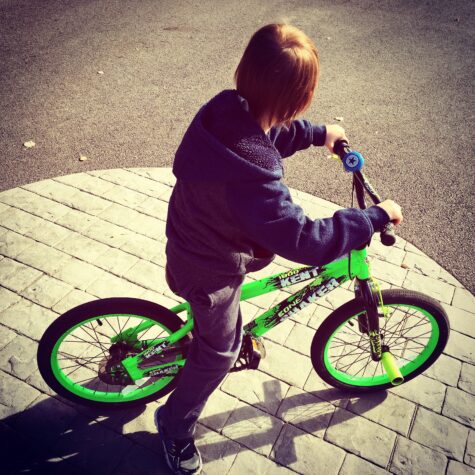
The situation was this: A 6-year-old rode off on his bike and stayed out for two hours, without his parents knowing where he was.
That would have had me, yep, me, very worried. But when a mom asked Slate for advice on how to deal with this situation – and with her husband saying this was no big deal, he used to ride his bike at that age — an advice-giver went ballistic.
“Even 10 minutes gone without explicit permission and knowledge of where exactly you could find him would have been too much! As soon as he was out of your sight, you should have been after him,” he wrote.
And, “Your kid is 6! He needs a parent with him when he’s outside riding his bike, period.”
But wait – there’s more!
“It’s the maturity to know what to do if he loses control of the bike and falls and hurts himself, or if a stranger stops him to talk to him, or if he comes across a mean dog without a leash, or any number of totally unforeseen things that can happen when we’re out in the world,” the advice-giver continued. As if the world must be free of all “unforeseen things” (good luck!) before we let kids do anything.
Wait till double digits
The advice-giver goes on to quote the American Academy of Pediatrics which, “advises age 11 or 12 is when most children are developmentally ready to be unsupervised. That’s twice the age of your son. He is just not ready for the responsibility of biking alone yet, and he won’t be for many years.”*
And then he gives two examples – actually stories I was the first person to report! – of moms having Child Protective Services called on them because their kids were outside unsupervised. (Incidentally, he gets the state where one of these happened wrong. It was Florida, not Maryland.)
Danger everywhere!
Finally, he does not correct the mom who wrote that when her husband was biking more than 30 years ago, “things were safer!” So —
My thoughts, point by point:
1 – REAL CRIME STATS
Things were not safer 30 years ago. Here is Let Grow’s Crime Stats page. Note that crime peaked in the early 90s and has been going down (with some blips) ever since.

2 – A LEARNING OPPORTUNITY
When a kid leaves for two hours without his telling parents where he’s going, this is – as commenters noted on Slate and on our Facebook Group, “Raising Independent Kids” – a learning opportunity:
“From now on, before you leave, you have to let us know where you are going.” “Please check in at _______.” “Be home by ________.” “If you change your plans, let us know.”
These are all reasonable things to teach your child, even at age 6. If they screw up, you tighten the reins and try again a little later.
3 – INCENTIVIZING RESPONSIBILITY
One commenter added that if the boy knows that no matter how responsible he is for the next six years, he will not gradually earn more freedom, what incentive does he have to start leveling up?
4 – LESS OUTDOOR TIME = MORE INDOOR (SCREEN) TIME
If a parent must be watching a child every second they are outside, the children won’t be outside much, because parents don’t have as much free time. Is it better for the kids to sit on an iPad all afternoon?
5 – 6-YEAR-OLDS AREN’T BABIES
The idea that kids age 6 can do nothing safely on their own is a new one. A checklist from the book, “Your 6-Year-Old: Loving and Defiant,” from 1979 includes:
Can he stand on one foot with eyes closed for five to ten seconds?
Can he tell the left hand from right?
Can he travel alone in the neighborhood (four to eight blocks) to a store, school, playground, or to a friend’s home?
In living memory, 6-year-olds were routinely allowed to venture away from home on their own. This was not only considered appropriate, it was recommended.
6 – REASONABLE CHILDHOOD INDEPENDENCE LAWS
The fear that CPS may be called is real, though not that likely. That’s why you’ve heard about the celebrated cases – I have brought most of them to public attention. The response is not to let the government second-guess or scare parents who know and love their kids best. It is to change the neglect laws – something Let Grow is doing. To date, we have helped pass Reasonable Childhood Neglect laws in 11 states that clarify “neglect” is only when you put your child in obvious and serious danger – not anytime you take your eyes off them. We are working in half a dozen more states right now. Trust is not neglect!
7 – THE DOWNSIDE OF “SAFETY”
The knee-jerk reaction that independence could lead to danger completely forgets the yin to that yang. Yes, a child could meet an unleashed dog outside. They could also grow anxious, depressed, obese, worried, sad, and lonely when they are “safe” inside. In fact, that is what has been happening over two generations now, according to this study. Why is only one half of this equation discussed?
8 – INDEPENDENCE IS CRUCIAL
Obviously at Let Grow we not only believe independence is good for kids, we think it is crucial! It’s like a vitamin that kids NEED to grow up physically and psychologically healthy.
9 – CULTURES GET SOME THINGS WRONG
Obviously we also know that we are at odds with some of those in authority. But when a culture gets something really wrong – no votes for women, no rights for minorities, no support for parents who want their kids to play outside – it is decent people’s job to bring these issues to light, and make them right. Let Grow exists to right the wrong that enshrines helicopter parenting as the only legitimate option.
10 – WHAT YOU CAN DO
If you’d like to help Let Grow pass more Reasonable Childhood Independence laws, click here!
If you’d like to join the conversation on our Raising Independent Kids Facebook group, please do!
If you’d like to print your child a free “Let Grow Kid License,” that says, “I am not lost or neglected!” here you go!

And if you’d like to give your own child more independence, please join Let Grow. We have free materials for parents who are independence-curious, and free programs for schools.
Parents will always differ on when they think kids are ready to start exploring the world. Baseless fearmongering should not sway their decisions.
* The AAP recommendation has to do with when a child is ready to deal with “emergencies.” Most of us – child or adult — aren’t truly ready to deal with robbers, terrorists, kidnappers. It’s a standard few of us could meet.
3 Comments
What absurd advice. I and all the other kids I knew were outside, all over the neighborhood and even beyond, completely on our own without adult supervision, by the time we were six. No play dates, no adult-planned activities, no nonsense. Just go out the door, see whatever other kids were out and about, play with them in yards, in vacant lots, in trees, on fences, in sheds, in canals, in the street, and be home before dark. I lived in sixteen different places when I was a kid, and it was the same everywhere. I never heard of any child who was catastrophically injured, kidnapped, or killed. There is no moral or practical reason it couldn’t be like that again. The problem is that irrational busybodies have got control, and manipulated the law to be on their side.
One of the problems with living in a low-risk society is that we never really learn to evaluate risk. We don’t encounter the dangerous, so we never learn to deal with it. And that just gets worse as our society becomes overall safer, and the risks that do exist loom over-large against our safe horizons.
And humans who don’t learn to evaluate risk are more likely to do stupid things (having developed no sense of what is or isn’t dangerous), and take longer to outgrow that.
So what we really need is more risk, even if that’s just kids riding their bikes and learning to negotiate traffic — because the skill of risk management will serve them well all their lives.
I get the whole protecting your kids thing, but that seems a bit extreme. What kind of activities are we talking about here?