
How did we get to the point where having an old-fashioned see-saw on the playground is something almost no park district would consider? Or that students crossing the street to visit the firehouse must get a signed waiver? Or that a school bus can’t let a 7-year-old off at the bus stop unless there’s an adult waiting there to walk them home half a block?
Philip Howard says it all began in the ‘60s. Not with the hippies – with the experts.
Goodbye, Common Sense.
“The idea we had back then was that we could prescribe the correctness of public choices with detailed rules,” say Howard, author, most recently, of Saving Can-Do: How to Revive the Spirit of America. “But actually, that’s not correct. Practically every situation involves human judgment in the circumstances.”
The post-war optimism about technocrats led America to start substituting regulations for what some of us call common sense. It was also the era when any untoward experience started to become a potential lawsuit. This combination, which was supposed to make our world safer and more fair, had the unintended consequence of making it stagnant and scary. Lots of rules meant lots of opportunities for punishment.
Tree stumps as “tripping hazards.”
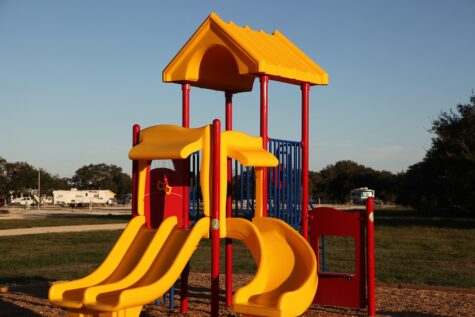
“Kids can’t go out and play because if they’re unsupervised and somebody had an accident, there might be a lawsuit,” says Howard. As for see-saws, merry-go-rounds, even tree stumps on the playground, “Anything where kids might fall could create a lawsuit too,” he says. “So the best thing to do is to get rid of them.”
The result is not just boring playgrounds. It’s bored kids, with fewer chances to learn to solve problems. “You no longer have the brain learning these social skills, because you have an adult overseeing them,” says Howard.
Perhaps Howard’s biggest bugaboo is the burgeoning books of standards that schools and other institutions, like day care centers and nursing homes, are required to follow. The problem with micromanagement from afar is that something that may be dangerous in one situation (walking home from a bus stop along a highway) isn’t dangerous in another (walking home along a quiet street), yet it is prohibited everywhere. And that rule is backed up with the threat that if a child is hurt, however randomly, there is always someone to blame.
Trusting teachers, principals, parents.
Administrators, in turn, are forced to think defensively instead of using their own best judgment: If saying no to this activity means no one will ever get hurt, how could I ever say yes?
But administrators – and teachers, and doctors, and all of us who have done our jobs for a while – have learned things. We have absorbed lessons. We have observed reality. And we should be able to make decisions based on what we KNOW but can’t necessarily PROVE.
This, too, has become taboo, says Howard. Even though wisdom is what you get from experience, we are not allowed to form our own ideas of what is sensible and safe enough. We are forced, instead, to comply.
Risk is part of life.
And when we are busy trying to make sure that we have done things exactly as outlined on page 78, sub-paragraph 5-H, we’re not getting smarter. “The regulatory state is literally mind-numbing,” Howard says. Load it up with rules and it can’t see the slide as anything other than a piece of equipment that is noncompliant, should it angle more than 43 degrees in a vertical direction.
Howard believes one solution to this state of affairs could be a Risk Commission that, perhaps like this Social Policy Journal piece, lays out what risks are appropriate – even crucial – for children at different ages. It would be based on child development, not risk aversion. It would be back-up for parents and schools who want to let their kids do more on their own. And the people on that commission?
They’d be allowed to use their judgment.

1 Comment
When I read about and see first-hand what the lives of children are like today compared to the 1950s and 1960s when I was a kid, I can hardly believe I’m still on the same planet. Regulations and protocols to meet every conceivable situation have removed the necessity for anyone in charge to ever use reasoning to decide what to do. It’s a nightmare from which society will never completely recover. Getting old is depressing, but remembering that I was privileged to be a child during a golden age of kid freedom makes it less so.